Your personal strengths profile and professional skills
Creativity, teamwork, communication skills, and willingness to help are personal strengths that can be presented as professional skiils should have an impact on the cover letter, the interview, and then later on your professional career job. In my blog article you will learn how to make targeted use of your personal strengths and how you succeed.
Before applying, analyse your soft skills
Everyone has strengths and weaknesses. In job interviews especially, it is likely the question about personal strengths and weaknesses will be asked, so the applicant should be well prepared for this. It is advisable to list and analyse your strengths and weaknesses before beginning your cover letter. The applicant can use this analysis to match their strengths with the social skills required in the job vacancy and address them in the cover letter as professional skills, while also learning to optimize your LinkedIn profile. and develop personality and work traits for professional growth
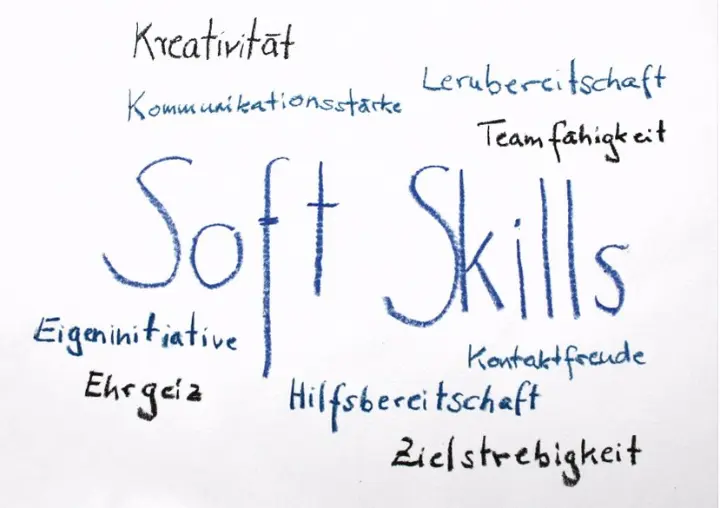
Application cover letter - describe personal strengths as professional skills.
The job offer describes the ideal candidate for the vacant post, but applicants whose qualifications match 80% of the requirements will be considered for the job. The cover letter is usually the first contact with the company and it should be individually adapted for each job opening. The success rate is considerably lower if a standardised application is used. Cover letters that are sent en masse do not leave a lasting impression with HR and usually the candidate will not be remembered.
Applicants score points for their personal strengths if they describe them in their cover letter and underpin them with concise and succinct examples. But be careful! HR reads phrases such as "I am creative", "I am mo-tivated", etc. often, so these don’t convey the positive impression that reading the letter should give. But if the applicant details their soft skills with examples/activities that they have experience in, the HR managers can assess the candidates better and in the best case scenario will invite them for an interview. Hard skills get you in the door, but it's the personality and work traits for professional growth that keep you moving forward
In the interview - present your strengths
Just as digital transformation changes all areas of of our daily lives, the new requirements of an engineer are not limited to new technical demands. The personality of the engineer is becoming more and more important. It is now up to the universities to include the changed requirements in the apprenticeship and up to the companies to successfully retain these specialists.
The interview is about self-presentation and both parties getting to know each other. When asked: "What are your strengths and weaknesses?" the applicant can address their personal strengths as professional skills. The candidate has the opportunity to explain and illustrate their soft skills already mentioned in the cover letter in more detail. Once you know your strengths, make them visible online – find out how to optimize your LinkedIn profile to attract the right opportunities.

Emphasise self-reflection and strengths
As already mentioned, the applicant should work out their strengths and weaknesses before their interview. Responses such as "That's a tough question," do not leave a positive impression on the interviewer. This ques-tion is not difficult to answer, because if you've prepared for the interview, you can smoothly identify your strengths and weaknesses. In particular, personal strengths that are required for the job will not be forgotten by the interviewer. If the ap-plicant describes their soft skills with activities and experience performed in their professional and private lives, the interviewer will have an informative image of the candidate. Strengths that are not required in the job post-ing but may still be relevant should also be mentioned and supported with examples. It depends on the self-reflection of the applicant. The more the candidate analyses their strengths, the better it is for the interviewer. Soft skills that are not relevant to the position still benefit the company, so do not hold back from mentioning them.
Addressing strengths and weaknesses
In the same breath, weaknesses will also be asked about after strengths. To have no weaknesses is impossi-ble and not the right answer to the question. Funny answers such as "I eat too much chocolate" are also not well received by the interviewer. As already mentioned, the interviewer should get an impression of the candidate at the interview and this also includes identifying their weaknesses. The best advice is to stick to the truth when answering the question. It depends on the packaging, on how the applicant formulates and presents their weaknesses. The candidate should demonstrate how they have dealt with their weaknesses to date. The weakness should not be per-ceived as a weakness by the end of the interview. The interviewer appreciates it if the candidate reflects upon themselves. Failure is a part of life, so it is not objectionable if the candidate mentions this and reveals what they learnt from the situation and how they deal with similar situations. Mentioning further education and train-ing shows the interviewer that the applicant has worked on their weaknesses and their soft skills. A great skill is to sell weaknesses as strengths and put the focus on the strengths.
A practical example
I expect, for example, ambition and commitment for an assistant position in HR management, which shows to me that the applicant might be the right one for the job. The candidate should also demonstrate confidence. Someone who knows what they can do and what they want is more compelling to me in an interview than a candidate who cannot reflect on themselves. The wide field of HR management requires a person who can deal with challenges. If the applicant works on their weaknesses such as attending a language course to im-prove their foreign language, I recognise the potential of the candidate.
Tips for the job interview
If you find it difficult to determine your personal strengths and weaknesses, ask friends and colleagues. Your social circle knows you well and can give you a picture of your soft skills. Tests also provide an overview of so-cial skills. In summary, soft skills help achieve success if the applicant is thoroughly prepared and presents their personal strengths with examples in the interview. What experience have you gained in job interviews? How did you gain points in an interview with your soft skills? I look forward to your experience and new insights.
Would you like to contribute your strengths directly? Then discover our current job vacancies in the job exchange or send us your unsolicited application—we look forward to getting to know you!