Insights
The IT sector attracts talent with promising IT jobs opportunities salaries. The world is interconnected. Everyone is digitally connected to their friends, who are scattered across the globe. Home heating can be easily controlled remotely via smartphone, ensuring a comfortably warm apartment upon arrival. Digitalization is everywhere! It's only logical that this is also transforming the world of work. Industry 4.0, the Internet of Things, and artificial intelligence have long since evolved from foreign concepts to everyday terms.
#1: Level of education
Graduating from school is often the first milestone and starting point of one's professional career. At this point, young people face an important decision – what's next, what do I want to do? The possibilities are numerous, a fact that doesn't make the decision any easier. Apprenticeship or university studies? Which field of study? What are the future prospects and what salary can I expect after an apprenticeship or university degree? According to the StepStone Salary Report 2018, the average salary in IT professions is around €64,837 (gross annual salary). However, the gap between university graduates and those without a degree is quite significant. A university degree is therefore a crucial factor for earnings, especially when starting out in the profession. A Master of Science degree, for example, has a particularly positive impact on salary at the beginning of an IT career. Later, once you have several years of professional experience, practical skills become more important. At that point, it's also possible for Bachelor's graduates or trained IT professionals to catch up with former Master's graduates in terms of salary over the course of their careers. Of course, the decision between a Bachelor's and a Master's degree shouldn't be based solely on financial reasons. The primary consideration is the specialization you intend to pursue. The more complex this specialization, the more beneficial it is to deepen your knowledge with a Master's degree. However, for some fields and career advancement opportunities, a higher degree, and sometimes even a doctorate, is required.
#2: Area of responsibility
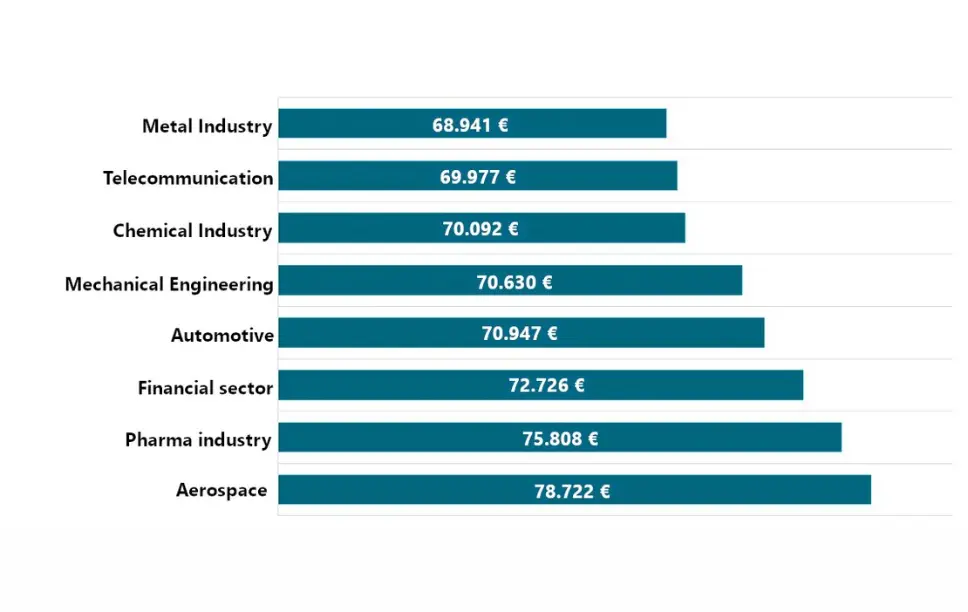
The IT sector is incredibly diverse, as are the tasks and areas in which you can develop your skills. The specific industry you choose also significantly impacts your salary. With the ongoing digitalization, IT professionals are in high demand almost everywhere. The aerospace and pharmaceutical industries attract specialists with particularly attractive salaries. IT security experts earn the highest average annual salaries, closely followed by IT managers and SAP consultants. SAP development and backend software development are also highly paid positions. This reflects SAP's importance in the economy. Since its founding, the company has become the largest European software manufacturer, with an annual revenue of approximately €23.5 billion. IT professionals in research positions can also earn high incomes. These often require formal qualifications such as a master's degree or a doctorate, which can rarely be replaced by professional experience alone. IT and engineering are converging fast – find out more about the skills and mindset shifts for future engineers shaping the industry.

#3: Company size
When discussing salary, consider what you can realistically expect from the employer and the company size. Larger companies usually offer higher salaries than small start-ups because they have more financial resources. In Germany, the salary difference between a small company and a large corporation can reach several thousand euros. Many employers offer additional benefits like bonuses, profit-sharing, company cars, Christmas bonuses, or pension plans. Top IT employers include companies such as Google, Microsoft, Apple, SAP, and the BMW Group. These rankings consider not only salary but also brand awareness and overall employer reputation. IT is just one part of a much bigger shift – explore all the new careers and jobs of the future that are on the rise.
#4: Region
Another crucial factor influencing both starting salaries and subsequent earnings is the region where the workplace is located. In Germany, a pay gap still exists in the IT sector between the former West German states and the former East German states. However, the industry is optimistic about future developments, as the German economy and labor market are considered strong. This is also reflected in the low unemployment rate of 4.9 percent in the first half of 2019. According to StepStone, Hesse offers the highest salaries in Germany. This is not surprising, given that the state capital, Frankfurt, is home to the financial center and many large corporations, such as Lufthansa AG and Commerzbank AG. The IT sector offers strong career prospects, with high demand for skilled professionals across almost all industries. This demand will continue to grow as connectivity and globalization remain major influences in the coming years. Salaries in IT are high and are expected to remain that way due to sustained market demand. Compared to many other professions, IT roles offer significantly higher earning potential.
If you're looking to advance your career with a reliable partner, explore the IT job opportunities on our job board. As a aviation expert, ARTS provides exciting IT positions across. You can apply directly for open roles or submit a speculative application to join the ARTS team.